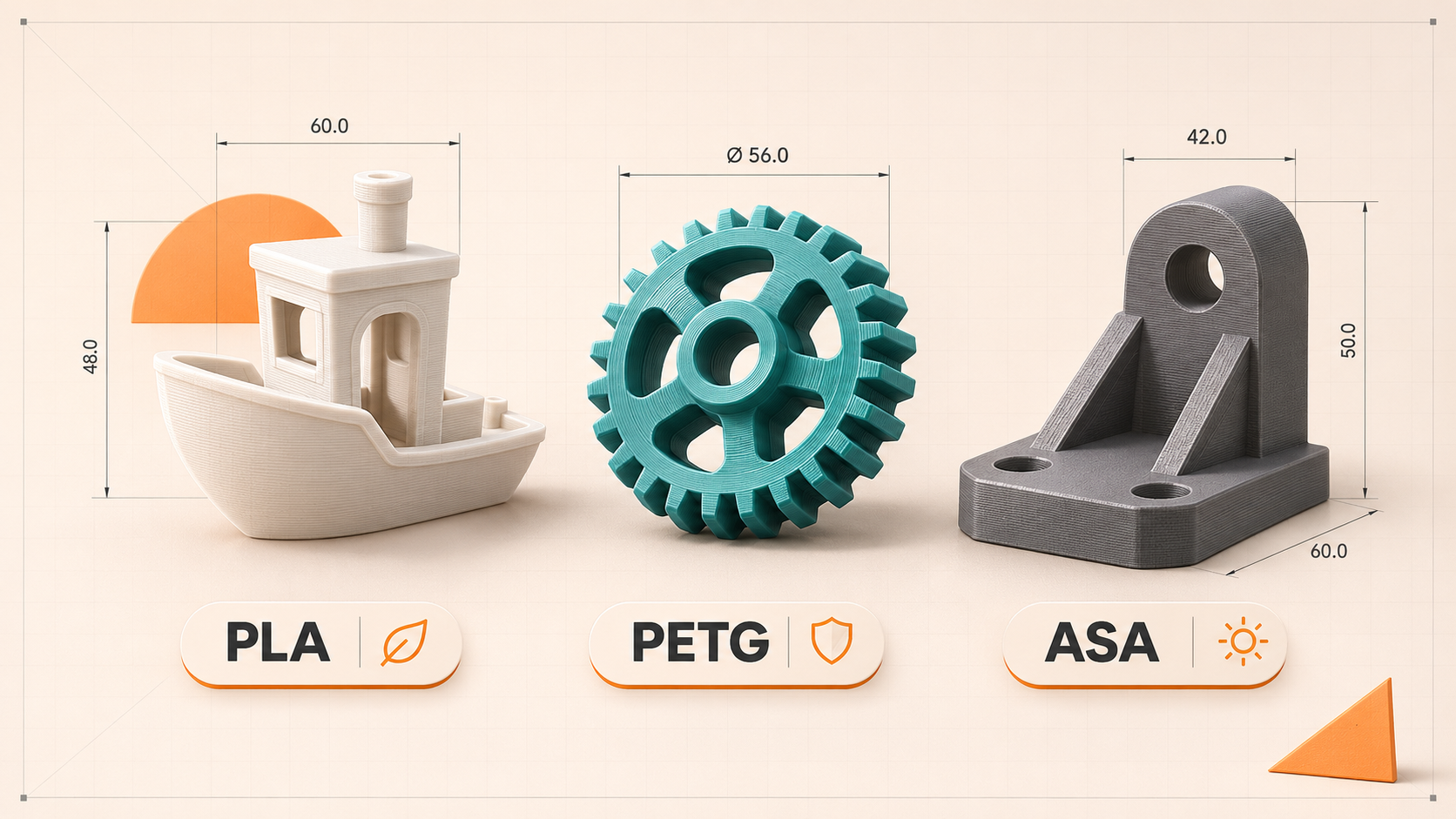
Short answer: choose PLA for anything that lives indoors, PETG for parts that get wet, take knocks or sit near warmth, and ASA for anything that lives outside in the sun or inside a hot car. If you are not sure, tell us what the part is for and we will pick for you.
The three materials at a glance
| PLA | PETG | ASA | |
|---|---|---|---|
| Best for | Indoor items, display, prototypes | Kitchen, bathroom, garage, clips that flex | Outdoors, cars, caravans, boats |
| Starts to soften at about | 55–60 °C | 75–80 °C | 95–100 °C |
| Sunlight (UV) | Fades and turns brittle | OK for a season or two | Designed for it |
| Water | Fine for splashes | Very good | Very good |
| Impact | Stiff, can snap | Tough, bends before breaking | Tough |
| Finish | Crisp, many colours | Slightly glossy | Matt |
| Price | Lowest | A little more | A little more |
PLA: the sensible default
PLA prints cleanly, holds fine detail and is the cheapest option. It is ideal for organisers, phone stands, cable tidies, replacement knobs inside the house and test-fit prototypes. Its weak spot is heat: a PLA part left on a dashboard in July can warp within an afternoon.
PETG: tougher and happier with water
PETG is the same family of plastic as drinks bottles. It is less brittle than PLA, handles damp and moderate heat, and is a good choice for garden hose fittings, bathroom hooks, garage brackets and clips that need a little give. It is not designed for years of direct sun.
ASA: built for outdoors
ASA was made for car trims and garden furniture. It keeps its colour and strength in sunlight and copes with the inside of a parked car. Use it for caravan and motorhome parts, boat fittings, number signs and anything bolted to the outside of a house. It needs an enclosed printer to print well, which is what we use.
Three questions that decide it
- Will it see sun or a hot car? Choose ASA.
- Will it get wet, flex or take knocks? Choose PETG.
- Neither? PLA is fine and costs the least.
Our quote tool asks the same thing in plain words (indoors, outdoors and sun, heat, load) and switches the material and price for you.
Questions
Is any of these food safe?
We do not sell printed parts as food safe. Layer lines can trap bacteria, whichever plastic is used. Cookie cutters and similar short-contact items are a grey area, so we treat them as decorative.
Which is strongest?
It depends on the load. PLA is the stiffest, PETG and ASA are tougher when hit or bent. How the part is designed and printed (walls, fill, orientation) usually matters more than the material.
Do you print ABS, nylon or resin?
Not at the moment. ASA covers most jobs people ask ABS for, with better weather resistance.